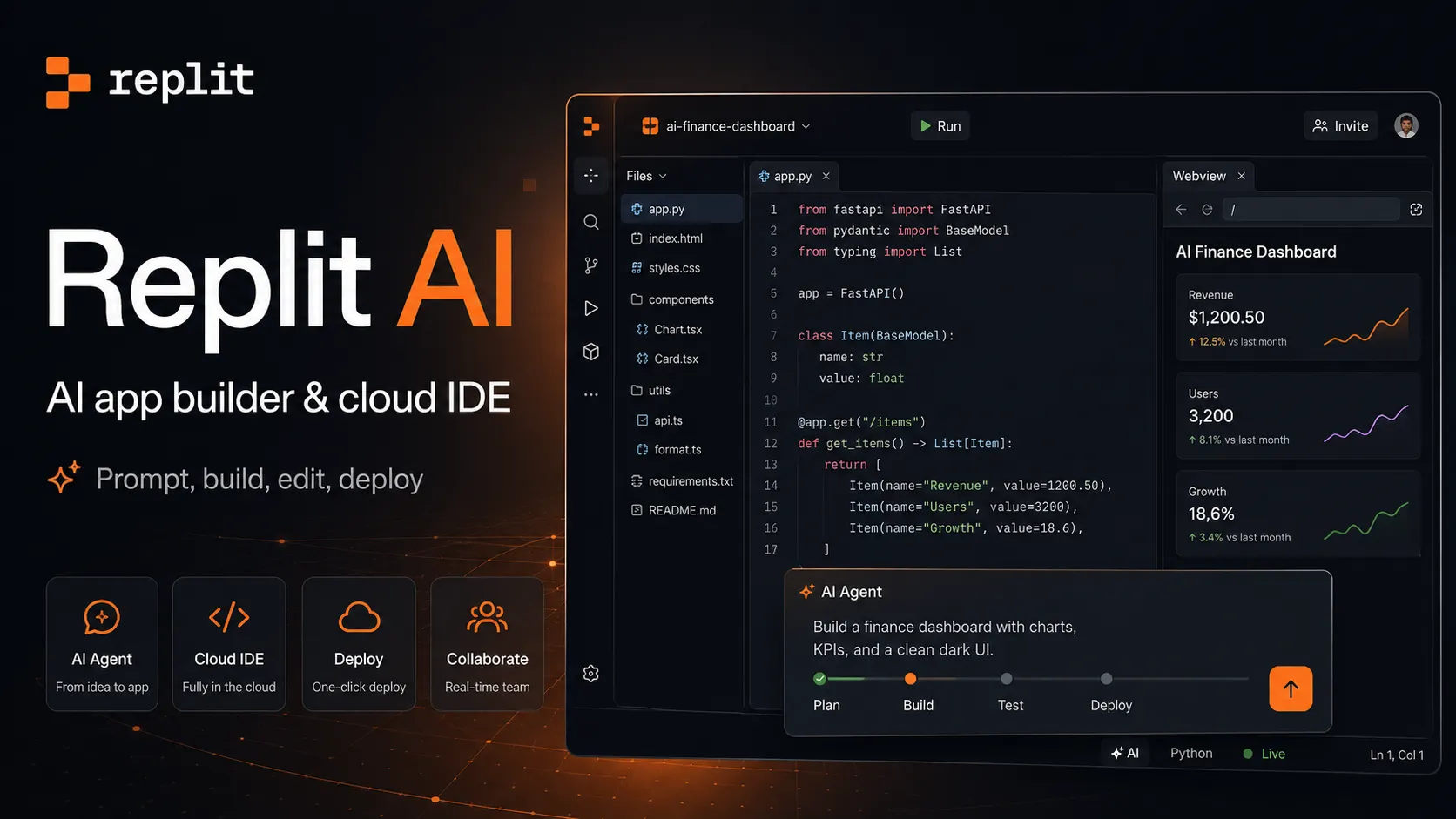
Remember when building an app meant installing an IDE, configuring a runtime, setting up a database, and wrestling with deployment configs for days before writing a single meaningful line of code? Replit killed that workflow. In 2026, the browser-based development platform has evolved from a simple cloud IDE into one of the most capable AI app builders on the planet — powered by its flagship Replit Agent.
What Is Replit Today?
Replit started in 2016 as a browser-based coding environment designed to remove setup friction for learners. A decade later, it serves over 50 million users and has raised $400 million at a $9 billion valuation (March 2026). The modern Replit combines:
- A full cloud IDE supporting 50+ programming languages
- Built-in database, authentication, and hosting
- One-click deployment to a live URL
- And most importantly: Replit Agent, an AI that builds entire apps from plain-language descriptions
Meet Agent 4
The current generation, Agent 4 (released March 2026), represents a leap in autonomy. You describe an app — “build me a booking system for my dog-grooming business” — and the Agent plans the architecture, writes the code, opens a real browser to test it, fixes what breaks, and publishes it to a live URL. All in one browser tab.
Key Agent 4 capabilities include:
- Parallel Agents — run up to 10 build subtasks simultaneously (auth, database, design) while tracking progress
- Infinite Canvas — visually design interfaces and apply designs directly to your app
- Multi-artifact projects — one project can produce web apps, mobile apps, slides, and videos sharing one database
- Autonomous debugging — the Agent detects and fixes errors without waiting for your input
The “Glass Box” Advantage
Unlike chat-to-app builders that hide the machinery, Replit is a glass box: every file the Agent creates is visible and editable. Semi-technical builders can inspect, tweak, and truly understand what was built. Combined with built-in hosting and 100+ integrations (Stripe, OpenAI, Google Workspace), you never need to leave the platform from idea to production.
Pricing in 2026
Replit overhauled its pricing in February 2026:
Starter—–Free——————-Daily Agent credits, 1 published app
Core——-$20/mo (annual)—–$25 monthly credits, 5 collaborators
Pro——–$95/mo (annual)——$100 credits, 15 collaborators, 10 parallel agents
Enterprise-Custom—————SSO/SAML, single-tenant, VPC peering
One honest caveat: Agent usage is effort-based, and costs can be unpredictable. A complex feature might cost several dollars in checkpoint charges, and careless iteration can burn through credits fast. Watch your usage dashboard.
Replit vs. the Competition
- vs. Lovable — Lovable produces more polished front ends and cleaner code export; Replit offers a complete build-run-deploy environment in one place.
- vs. Bolt.new — Bolt is faster and more framework-flexible; Replit’s Agent is more autonomous with stronger built-in infrastructure.
- vs. Cursor — Cursor augments developers in their existing repos; Replit targets builders who want a live URL without touching local environments.
Who Should Use Replit?
Replit fits founders prototyping an MVP, students learning to code, hackathon teams, and non-technical builders who want a real, deployed product — not just a mockup. If you want to see and own every line of code while still moving fast, the glass-box approach is compelling.
Final Verdict
Replit has quietly become one of the most complete AI development platforms available. Agent 4’s parallel builds, autonomous testing, and all-in-one infrastructure make it the fastest path from “I have an idea” to “here’s the live link.” Just keep an eye on that effort-based meter.
What’s the first app you’d build with an AI agent? Drop your ideas below!