Monument Valley 2 Review 2026: Is This Mobile Puzzle Game Worth Playing?
Some puzzle games challenge you with complicated rules. Monument Valley 2 takes a different approach. Its puzzles are built around perspective, unusual architecture, and the moment when a seemingly impossible path suddenly makes sense.
Developed by ustwo games, Monument Valley 2 follows Ro and her child through a series of surreal environments. Players guide the characters through geometric structures, rotate parts of the scenery, and uncover routes that are not immediately obvious.
The result is a puzzle game that feels closer to exploring a collection of interactive artworks than working through a traditional series of brainteasers.
But does its visual design come with satisfying gameplay? And is Monument Valley 2 worth playing on a phone in 2026? Here is a closer look at its puzzles, story, mobile controls, and overall value.
1. How Do the Puzzles Work?
The central idea behind Monument Valley 2 is simple: what you see is not always how the level works.
A staircase might appear to end in midair. Two platforms may look too far apart to connect. After rotating a structure or moving a section of the environment, however, the perspective changes and a new route becomes possible.
This is where the game gets most of its satisfaction. Instead of memorizing combinations or reacting quickly, you need to look carefully at the shapes in front of you and work out how they fit together.
The controls are relatively straightforward. You tap to guide the characters and interact with parts of the environment. The more demanding part is understanding which objects can move and how a change in perspective affects the available path.
Monument Valley 2 also introduces interactions that involve both Ro and her child. Some puzzles require you to consider their positions together, adding another layer to the familiar perspective-based design.
The difficulty generally comes from seeing the solution rather than executing it. That makes the game approachable for casual players, although anyone expecting complex logic puzzles may find some sections less demanding than anticipated.
2. A Story About a Mother and Her Child
Monument Valley 2 is not simply a collection of disconnected puzzle levels. Its journey follows Ro and her child as they move through the valley and gradually develop a relationship of their own.
The story is told with relatively little dialogue. Character movements, changes in the environment, and the distance between the two characters often communicate more than a long conversation would.
This understated approach suits the game’s visual style. Rather than interrupting every level with explanations, the game allows players to interpret what is happening as they progress.
The mother-and-child relationship also gives the puzzles a purpose beyond reaching the exit. Their changing roles and occasional separation become part of the experience, making the journey feel more personal than a sequence of abstract challenges.
However, players should not expect a dialogue-heavy RPG or a story full of detailed character development. The narrative is deliberately restrained, and much of its meaning comes from presentation rather than explicit explanation.
If you enjoy games that leave room for interpretation, this approach can work well. If you prefer a clear, dialogue-driven plot, the story may feel too subtle.
3. Visual Design and Sound
The presentation is one of Monument Valley 2’s strongest features.
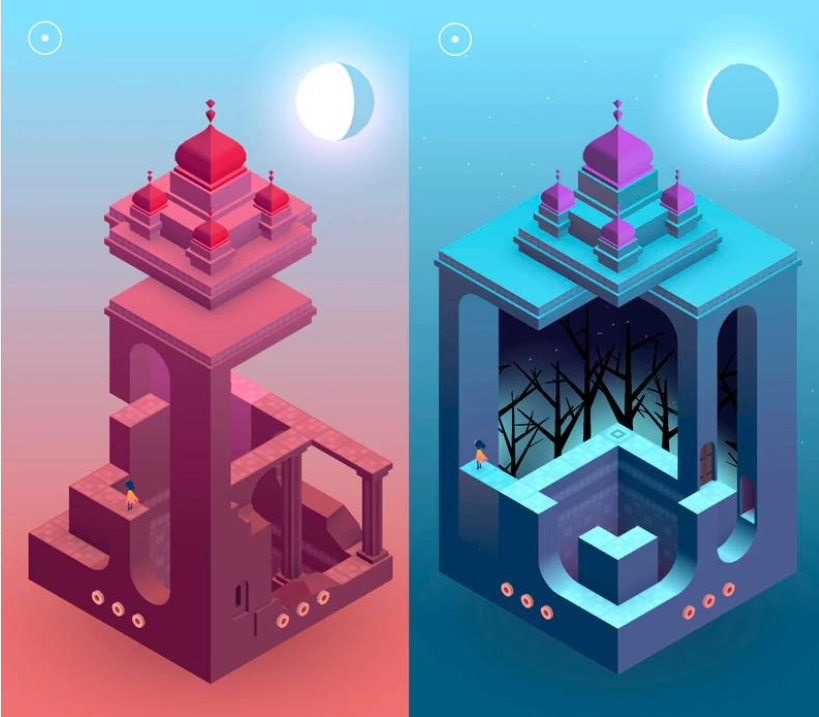
Its levels use geometric shapes, carefully arranged structures, and bold color combinations to create places that seem impossible but remain understandable once you interact with them. Buildings become part of the puzzle rather than serving as decoration in the background.
That distinction matters. In many mobile games, attractive scenery is something to look at while the gameplay happens elsewhere. Here, the architecture is the gameplay. The way a bridge aligns, a staircase turns, or a platform shifts is directly connected to solving each level.
The sound design supports this quieter experience. Music and environmental sounds help establish the mood without demanding constant attention.
Together, the visuals and audio give the game a consistent identity. You can often recognize its style from a single screenshot, which is a significant part of its appeal.
There is a trade-off, though. Players who care more about mechanical depth, equipment upgrades, or complex progression systems may find the presentation more memorable than the underlying challenge.
4. How Does It Feel on a Phone?
Monument Valley 2 is well suited to touchscreen interaction because its controls do not depend on fast reactions or complicated button combinations.
Most actions involve tapping a location, guiding a character, or manipulating part of a structure. This keeps the interface relatively easy to understand, even for people who do not regularly play mobile games.
The level-based format is another advantage. You can focus on a puzzle, take a break, and return when you have time. There is no competitive match to finish or multiplayer team waiting for you.
Screen size can affect the experience. The geometric details are part of how each puzzle communicates its solution, so a larger phone or tablet may make some elements easier to inspect. On a smaller screen, you may need to pay closer attention to the layout.
The game’s deliberate pace also means that touchscreen precision is usually less important than observation. If a route does not make sense immediately, you can take a moment to examine the environment instead of rushing through a timed challenge.
For players who want a calm game to enjoy during a break or before bed, this design is a natural fit.
5. Is Monument Valley 2 Worth the Price?
Monument Valley 2 has traditionally been sold as a premium mobile game, although current pricing and purchasing options vary by store and region.
Its value is better judged by the quality of the experience than by the number of hours it offers.
Each level is designed around a specific visual idea, and the game focuses on introducing and developing those ideas rather than stretching the experience with repetitive tasks. This gives it a clear sense of purpose, but it also means it is not designed to provide endless progression.
If you enjoy discovering how a puzzle works, appreciate carefully composed visuals, and prefer a game with a defined journey, that focused approach can be a strength.
On the other hand, players looking for hundreds of hours of gameplay, daily rewards, character upgrades, or frequent new challenges may find less to return to once they have finished the main journey.
Before purchasing, check the current listing for your device and region. Confirm the price, supported operating system, and included content rather than relying on an older review or an outdated store description.
6. Pros and Cons
Pros
- Distinctive perspective puzzles: Levels encourage you to rethink how paths and structures connect.
- Recognizable visual design: Geometric architecture and color choices give the game a strong identity.
- Touchscreen-friendly controls: Most interactions rely on tapping and manipulating the environment.
- A restrained narrative: The relationship between Ro and her child adds meaning to the journey without relying on lengthy dialogue.
- Relaxed gameplay: There is little emphasis on competition or fast reactions.
- A focused experience: The game concentrates on its puzzles rather than adding unrelated progression systems.
Cons
- Limited long-term progression: It is not designed around endless content or ongoing character development.
- Gentle difficulty for some players: Experienced puzzle fans may want more demanding challenges.
- A relatively short-form structure: Players who prioritize a large amount of replayable content may want more.
- Storytelling leaves room for interpretation: The restrained narrative may not suit players who prefer explicit explanations.
- Presentation is central to the appeal: If you are not interested in visual design, some of the game’s biggest strengths may matter less to you.
7. Who Should Play Monument Valley 2?
Monument Valley 2 is a good option for players who enjoy visual puzzles, unusual architecture, and games that reward careful observation.
It may also suit people who do not normally play games. The controls are easy to understand, and the experience does not require learning a complicated collection of systems before getting started.
The game is particularly appealing if you prefer to solve one thoughtful puzzle at a time rather than compete against other players or manage a long list of objectives.
It is less suitable for anyone who expects demanding logic challenges throughout, extensive character customization, or an ongoing progression system.
Before buying, consider what you want from a puzzle game. If the satisfaction of seeing an impossible-looking structure become a usable path sounds appealing, Monument Valley 2 is worth considering. If you mainly want a game that keeps adding new systems and rewards, another title may offer better value.
Frequently Asked Questions
Is Monument Valley 2 difficult?
The game focuses on visual reasoning and perspective rather than complicated controls. Some puzzles may take time to understand, but players looking for consistently difficult logic challenges may find the overall experience relatively accessible.
Can you play Monument Valley 2 in short sessions?
Yes. Its individual puzzle levels make it suitable for shorter play sessions. You can work through a section at a time instead of committing to a long multiplayer match or extended campaign session.
Is Monument Valley 2 free on mobile?
It has traditionally been sold as a paid game on mobile platforms. Pricing, availability, and promotional offers can change, so check the current Apple App Store or Google Play listing for your region.
Do I need to play the first Monument Valley before starting Monument Valley 2?
No. The developer describes Monument Valley 2 as a standalone adventure with a new story. You can start with the second game without completing the original first.
Is Monument Valley 2 worth playing in 2026?
It is worth considering if you enjoy perspective-based puzzles, distinctive art direction, and a quieter style of mobile gameplay. Its limited emphasis on long-term progression means it may not suit players looking for an endlessly replayable game.
Final Verdict: A Puzzle Game That Makes Perspective the Challenge
Monument Valley 2 builds its identity around a clear idea: changing the way you look at a structure can change what is possible.
Its perspective puzzles, geometric environments, and understated story work together to create a focused experience. Touchscreen controls make the basic interactions easy to understand, while the level-based format suits players who prefer to play at their own pace.
Its main limitation is also part of its design. This is not a game built around endless progression, demanding combat, or a constant stream of new objectives. Players who want those features may finish the experience without feeling a strong reason to return.
Our verdict: Monument Valley 2 is worth considering if you want a visually distinctive mobile puzzle game with intuitive controls and a thoughtful atmosphere. It is less compelling for players who prioritize high difficulty or long-term replayability, but its carefully designed puzzles give it a clear appeal of its own.