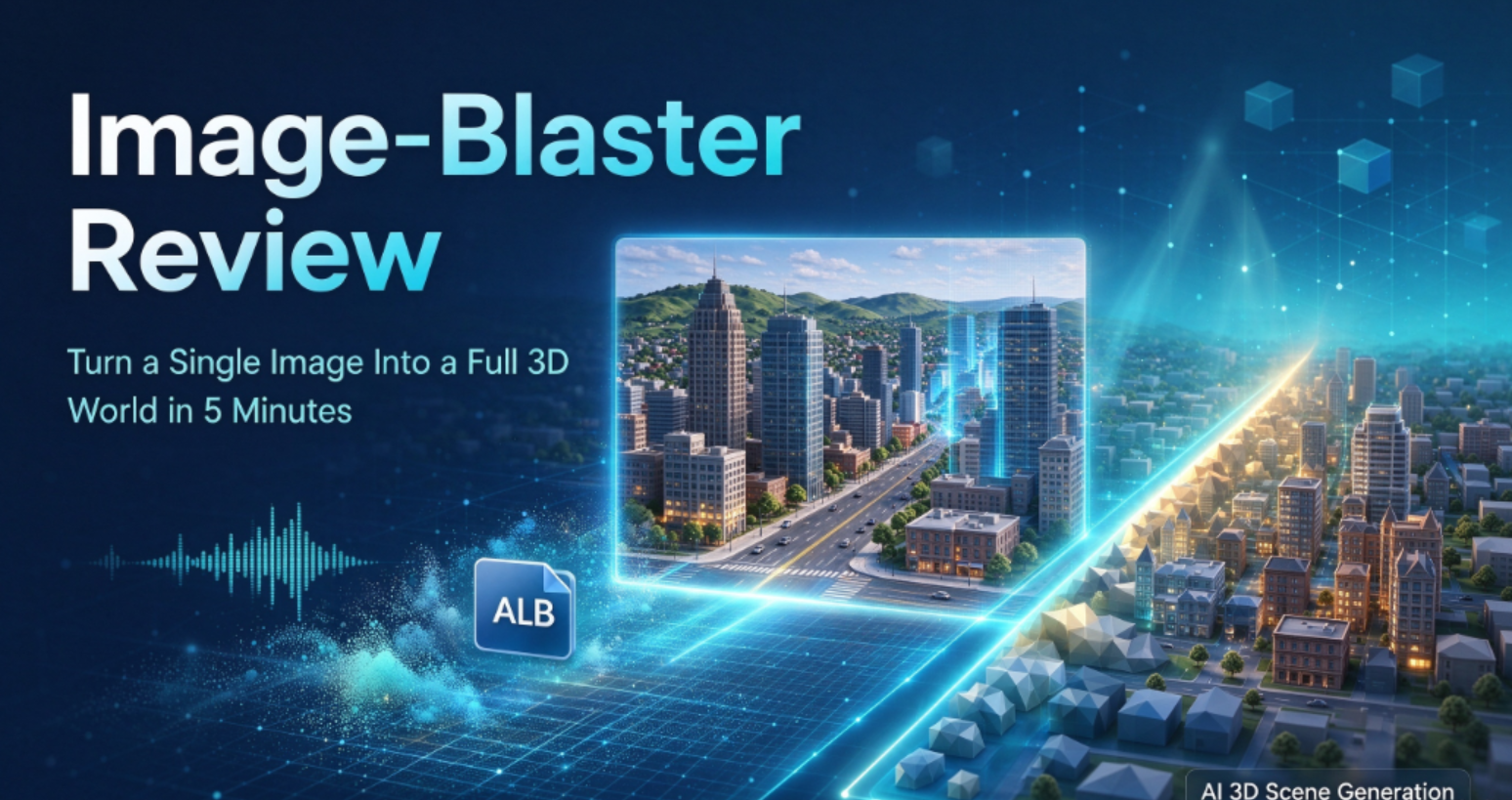
3D content creation has long been known for its steep learning curve, time-consuming workflows, and high technical barriers. Building an explorable 3D environment, generating textured meshes, and designing matching spatial audio usually takes professional artists hours or even days. However, the emerging open-source AI tool Image-Blaster is completely rewriting this rule. It can convert a single 2D image into a complete, explorable 3D scene with meshes, Gaussian splats, and custom sound effects in under five minutes, bringing a disruptive lightweight solution for game developers, 3D designers, architectural creators, and AI enthusiasts .
Launched in April 2026 and rapidly updated by independent GitHub developer neilsonnn, Image-Blaster has quickly gained over 3.7k GitHub stars thanks to its all-in-one pipeline and open-source advantages . Unlike traditional single-function AI image tools, it is a Claude-based composite AI workflow that integrates multiple top-tier third-party models to realize one-click full-stack 3D asset generation. In this article, we will dive into its cutting-edge features, pricing model, core pros and cons, and applicable scenarios to help you figure out whether this tool is worth adding to your creative workflow.
What Exactly Is Image-Blaster?
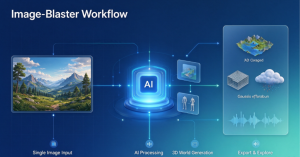
Image-Blaster is an open-source, MIT-licensed AI creative pipeline built for Anthropic’s Claude AI . It is not a standalone desktop software or web app, but a set of customizable Claude skills that orchestrates professional AI models including World Labs, FAL Hunyuan 3D, and ElevenLabs. Its core capability is simple and powerful: input one single 2D photo or concept art, output a complete 3D world with meshes, spatial environments, and ambient audio within 5 minutes .
Different from traditional image-to-3D tools that only generate simple static models, Image-Blaster builds a systematic creative pipeline covering image preprocessing, 3D object modeling, scene environment reconstruction, and audio matching. All generated assets support mainstream 3D software and game engine embedding, perfectly connecting AI generation and industrial creative workflows .
Cutting-Edge Core Features of Image-Blaster
What makes Image-Blaster stand out from numerous AI 3D tools is its integrated full-scene generation capability and highly customizable industrial-grade parameters. Its frontier functions are far beyond basic 2D-to-3D conversion, covering multiple core links of 3D content creation.
1. 5-Minute One-Click 3D Scene Full Reconstruction
This is its most flagship feature. Users only need to upload a single 2D image, and the tool will automatically complete all generation steps without manual intervention. It adopts a dual-engine collaborative mode: using World Labs’ marble-1.1 model to generate high-precision Gaussian splat (.spz) static environments, and leveraging Tencent’s Hunyuan 3D model via FAL API to build independent 3D dynamic objects . The final output is an explorable, spatially consistent 3D scene rather than a flat single model.
2. Multi-Format Industrial-Grade 3D Asset Output
Image-Blaster supports mainstream professional 3D file formats, fully adapting to commercial creative needs. It can export standard 3D object files including .glb and .obj, as well as Gaussian splat .spz files for real-time scene rendering . Advanced users can freely adjust core parameters such as polygon count (40,000–1,500,000 faces), PBR material rendering, and polygon types (low-poly/geometric/normal) to balance model precision and file size .
3. Automatic Spatial Audio Matching
Breaking the limitation of pure visual generation tools, Image-Blaster integrates ElevenLabs’ professional SFX model to automatically generate scene-matched ambient sounds and object-specific sound effects in MP3 format . For example, it will generate wind and bird chirping sounds for outdoor landscape images, and quiet indoor ambient sounds for room scene images, realizing synchronous audio-visual 3D scene restoration and greatly improving scene immersion .
4. Intelligent Image Preprocessing & Optimization
Equipped with built-in nano-banana image cleaning model (optional gpt-image-2 replacement), it automatically optimizes input images, removes noise, fixes blurry details, and standardizes image parameters . This preprocessing step effectively improves the accuracy of subsequent 3D reconstruction and avoids model distortion caused by low-quality input images.
5. Full Platform Compatibility & Embeddable Pipeline
All assets generated by Image-Blaster are perfectly compatible with mainstream 3D creative ecosystems, including game engines (Unity, Unreal Engine, Godot), professional DCC software (Blender, 3DS Max, Maya), and web 3D frameworks (Three.js, Electron) . Meanwhile, it supports web, API, and CLI multi-terminal invocation, and provides an optional React in-browser preview viewer, realizing one-stop generation, preview, and export .
6. Highly Composable Open-Source Architecture
Different from closed commercial AI tools, Image-Blaster adopts a modular open design. Users can freely replace and upgrade underlying AI models according to needs—for example, replacing the default Hunyuan 3D with a newer 3D generation model by simply updating the API string . This composable feature makes it always adaptable to the latest AI technology iterations, with far stronger scalability than fixed-function tools.
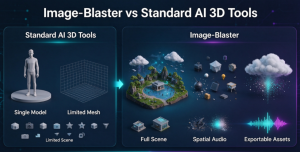
Image-Blaster Pricing & Cost Structure
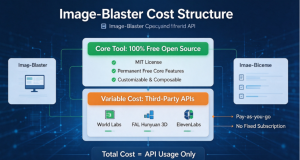
Image-Blaster adopts a completely free open-source core + third-party API pay-as-you-go model, with no fixed subscription fees or hidden charges, which is extremely cost-effective for individual users and small teams.
1. Core Tool: 100% Free Open Source
The entire Image-Blaster source code is open-sourced on GitHub under the MIT License. All core functions including image-to-3D conversion, Gaussian splat generation, audio matching, and format export are permanently free for personal and commercial use. Users can freely download, modify, and secondary develop the code without copyright restrictions .
2. Only Variable Cost: Third-Party API Fees
The only cost comes from the paid APIs of integrated third-party models (World Labs, FAL, ElevenLabs), which are charged on a pay-as-you-go basis according to generation times and resolution, with no minimum consumption limit . For personal hobby use, the free quota of each platform can basically meet daily needs; for commercial batch generation, the comprehensive API cost is far lower than manual 3D modeling labor costs.
3. No Additional Charges
There are no advertisement fees, preview fees, high-resolution export fees, or commercial authorization fees. The optional React viewer and multi-terminal invocation functions are also completely free .
Image-Blaster: Pros & Cons
As a cutting-edge emerging AI pipeline, Image-Blaster has obvious innovative advantages, and also has some limitations in industrial application. We sort out its core advantages and shortcomings based on actual user feedback and technical tests.
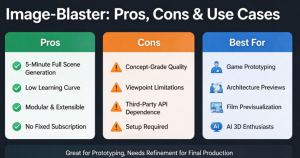
Core Advantages
-
Ultra-high creation efficiency: Completes the full process from single image to explorable 3D scene + audio in 5 minutes, saving 90%+ of manual modeling time, which is an efficient tool for rapid prototyping and concept verification .
-
Zero threshold for beginners: Based on Claude natural language control, no professional 3D modeling technology is required. Ordinary users can complete professional-level 3D scene generation with simple prompts .
-
Strong scalability and flexibility: Modular open-source architecture supports free replacement of underlying models and parameter customization, adapting to different precision and style creation needs .
-
Full-link asset integrity: One-stop output of models, scenes, and matching audio, avoiding the tedious splicing work of multiple tools in traditional workflows .
-
Low use cost: Core functions are permanently free, only relying on low-cost third-party APIs, with extremely high cost performance for individuals and small teams .
-
Wide compatibility: Generated assets are compatible with all mainstream 3D software and game engines, seamlessly docking with industrial creative workflows .
Existing Limitations
-
Only concept-grade asset quality: The generated models and scenes are suitable for conceptual design and prototype display, but the texture resolution, UV mapping, and face count precision cannot meet final commercial production standards. Secondary refinement via Blender, Maya and other software is required for formal projects .
-
Single-image information limitation: Affected by the input 2D image, the tool cannot accurately identify occluded objects and out-of-frame spaces. The system can only generate speculative content, which may lead to unreasonable scene details .
-
Viewpoint exploration restrictions: The generated 3D scene has a limited effective exploration range. When viewing angles exceed the original image frame or observing the back of objects, detail distortion and missing may occur .
-
Dependent on third-party APIs: The normal operation of all functions relies on external API interfaces. Generation failure or delay may occur due to API latency, quota exhaustion, or service suspension .
-
Certain deployment threshold: It is not an out-of-the-box software. Users need to complete repository cloning and API key configuration, which is slightly difficult for pure novice users without technical foundation .
Best Use Cases & Who Should Use It
Combined with its functions and limitations, Image-Blaster is not suitable for high-precision commercial final production, but it shines brightly in rapid prototyping and conceptual creation:
-
Game developers: Quickly generate game level concept scenes and prototype maps to verify scene layout and gameplay logic in the early stage of project development .
-
Architectural & interior designers: Convert design renderings into explorable 3D space scenes to quickly display spatial effects to customers .
-
Film & video creators: Rapidly build virtual shooting scenes and previsualization scenes to improve preliminary shooting planning efficiency .
-
AI & 3D enthusiasts: Low-cost trial of cutting-edge AI 3D generation technology, supporting secondary development and workflow customization .
-
Education & simulation: Quickly build simple simulation environments for teaching display and experimental verification .
Final Verdict: Is Image-Blaster Worth Trying in 2026?
Image-Blaster is a revolutionary lightweight AI 3D creation pipeline that subverts traditional inefficient 3D production workflows. Its core value lies in realizing “zero-threshold, ultra-fast full-scene 3D iteration”, filling the gap in the market for rapid conceptual 3D asset generation .
For individual creators, hobbyists, and small teams focused on conceptual design and prototype verification, it is a must-try tool—free core functions, powerful integrated generation capabilities, and flexible scalability can greatly improve creative efficiency and reduce production costs. For professional teams pursuing high-precision final commercial assets, it can be used as an auxiliary preliminary generation tool to save manual modeling time, with subsequent fine polishing required .
As an actively updated open-source project, Image-Blaster is still iterating rapidly. With the upgrading of underlying AI models and the optimization of self-contained algorithms, its asset precision and scene restoration capabilities will be further improved, and it is expected to become a core tool in the AI 3D creation track .
FAQs About Image-Blaster
Q1: Is Image-Blaster completely free for commercial use?
A: Yes. The project adopts MIT open-source license, allowing free commercial use, modification and distribution of the source code and generated assets. Only third-party API usage fees need to be borne by users themselves .
Q2: Do I need professional 3D skills to use Image-Blaster?
A: Basic use requires no 3D technology, only simple natural language prompts and API configuration operations. Advanced parameter tuning and secondary development need certain technical capabilities .
Q3: Can the generated 3D models be directly used for game release?
A: Not recommended for direct use. The assets are concept-grade and need manual refinement of textures, details and UVs to meet commercial release standards .