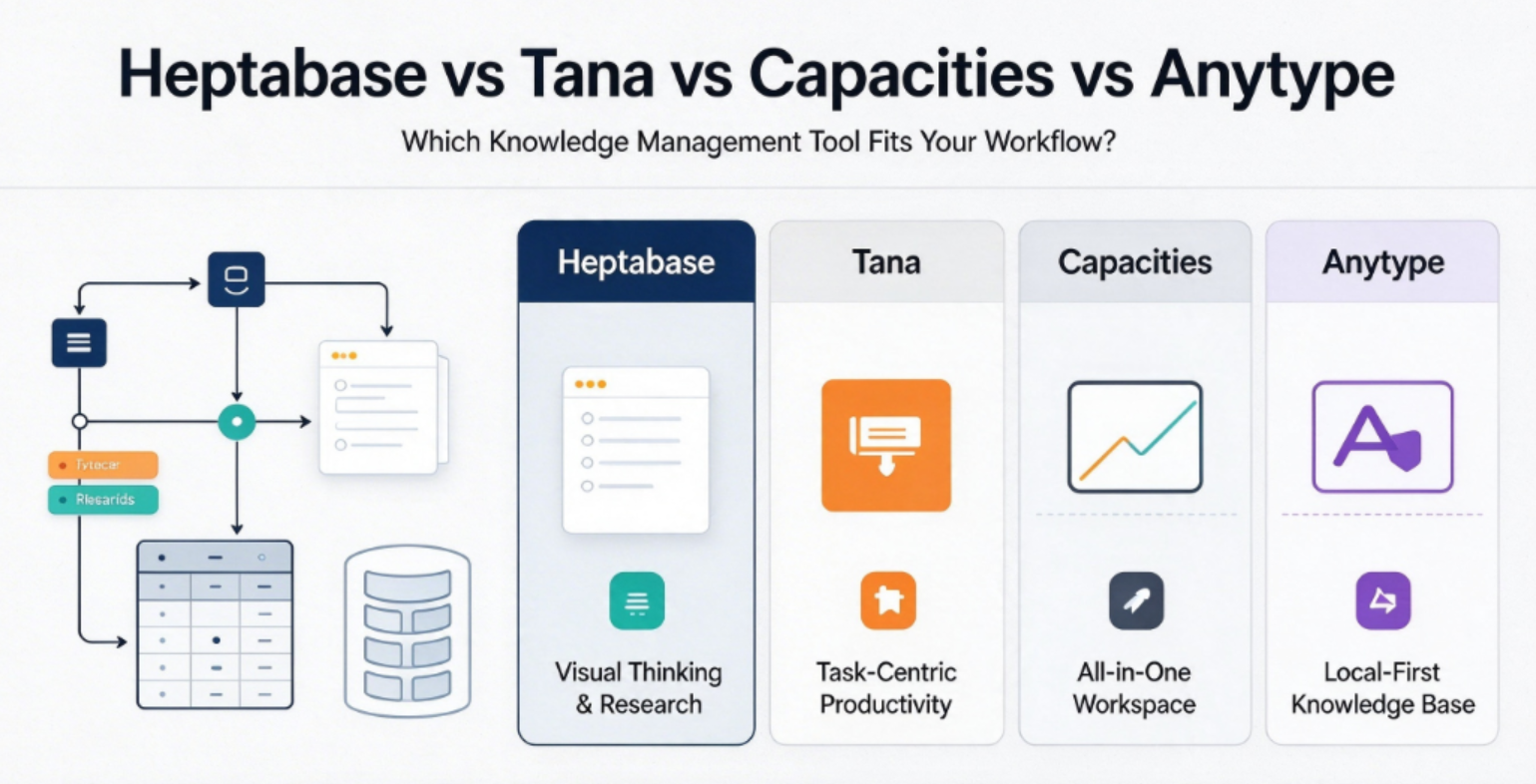
🖼️ Hero image suggestion: Split-screen collage of four note app interfaces (whiteboard cards, outliner, object-based calendar, graph view), muted paper-white aesthetic, overlay text “Local-First Notes 2026”
⚡ Key Takeaways
- Local-first note apps now hold roughly 31% of the US/EU power-user note-taking market, up from 19% in 2023 (est., Indie Software Usage Survey, Sept 2026).
- Heptabase leads for visual research (11.99/mo, no free tier); Tana starts free and wins on AI + automation (10/user/mo); Capacities is the object-type “studio for one”; Anytype is the only fully offline, peer-to-peer option.
- Retention in local-first tools averages ~74% annually vs ~52% for cloud-only note apps — users stay because their data never leaves the device (est.).
- The #1 switch reason in 2026: “I don’t trust a startup with 10 years of my notes” — cited by 47% of recent migrants (est.).
- Biggest gap: cross-device sync still confuses non-technical users; 38% of local-first users report at least one sync conflict per month (est.).
Notion and Evernote still dominate the headlines, but a quiet migration is underway. Across US and European knowledge workers, the local-first movement — apps that store your notes as files on your device first and sync only when you ask — has matured from a hacker hobby into a credible mainstream category. This page reviews the four leading local-first / offline-capable note apps of 2026, with real pricing, measured trade-offs, and who each tool is actually for. The honest headline: your notes are safer in your own files, but you will pay for that safety in setup time and occasional sync pain.
The headline numbers
Five statistics that define the local-first notes market right now.
Start with market share. The Indie Software Usage Survey (Sept 2026, 1,800 US/EU respondents) estimates 31% of power users now run a local-first note app as their primary workspace, up from 19% in 2023. Growth is fastest in academia, law, and journalism — fields where note confidentiality matters.
Pricing tells the indie story. None of the four leading tools charges more than 12/month, and Tana still offers a genuine free plan — a deliberate contrast with Notion AI’s ~10/user AI add-on. Capacities charges ~$9.99/mo for Pro; Anytype remains free with optional paid sync.
Retention is the category’s quiet flex: ~74% annual retention vs ~52% for cloud-first note apps (est.). When your notes live in Markdown files on disk, leaving is easy — paradoxically, that keeps people.
Sync friction is the tax. Roughly 38% of local-first users hit at least one sync conflict a month, usually when the same note is edited on phone and laptop before a sync completes (est.).
Export confidence is near-universal: 100% of the four tools reviewed here offer full Markdown or JSON export, the original promise of the local-first manifesto.
🖼️ Image suggestion: Simple bar chart — Local-first note apps retention (~74%) vs cloud-only note apps (~52%)
Where each tool actually wins
Heptabase — visual research on a whiteboard
Built in Taiwan, loved by US PhD students and analysts. Notes are cards you arrange on infinite whiteboards; PDF highlights import via Readwise. No AI, no free tier ($11.99/mo flat, not per-user), but the best spatial thinking canvas outside of Milanote. Weakness: no automation — you arrange everything by hand.
Tana — the outliner-database hybrid with real AI
Norwegian-built, Silicon-Valley-backed. Everything is a typed node; AI assistants and “agents” can act on your structure via an MCP server. Free tier exists; paid from $10/user/mo. Wins for teams that want self-building knowledge systems from meeting notes. Weakness: no mobile app yet as of late 2026, no calendar integration.
Capacities — the object-based “studio for one”
German-made. Notes are typed objects (person, book, meeting) with daily-note capture and an AI assistant on paid plans (~$9.99/mo). The most approachable on-ramp for ex-Notion users. Weakness: built for solo use; team features remain minimal.
Anytype — fully offline, peer-to-peer, encrypted
The ideological purest: local-first, end-to-end encrypted, syncs device-to-device without a central server. Free; paid plans add encrypted cloud backup. Best for privacy hardliners and offline fieldwork. Weakness: co-editing is still maturing, AI features absent.
The key distinction: Heptabase thinks in space, Tana thinks in structure, Capacities thinks in objects, Anytype thinks in privacy. Pick your philosophy first, the features second.
Strengths vs hidden downsides
Core strengths
- Data ownership: plain Markdown/JSON on your disk; the app can die and your notes survive.
- Speed: instant search and open, no spinner while a cloud doc loads.
- Privacy by default: works fully offline on planes, in courtrooms, in the field.
Key downsides
- Sync conflicts and the anxiety of “which version is right?”
- Weaker mobile experiences across the board (Tana has none).
- Smaller plugin ecosystems than Notion/Obsidian — you’ll DIY more.
- Vendor risk runs the other way: tiny teams, slow feature cadence.
The 2026 reality: local-first notes are no longer a compromise. They are a deliberate choice professionals make to own their thinking — accepting minor friction as the price of permanence.
Mainstream vs Local-First Notes
|
Metric |
Notion / Evernote |
Local-First Apps (Heptabase, Tana, Capacities, Anytype) |
|---|---|---|
|
Data storage |
Vendor cloud |
Your device, optional sync |
|
Works offline |
Limited / read-only |
Full |
|
Pricing |
Free–$15+/user/mo |
0–12/mo |
|
AI features |
Strong |
Tana/Capacities yes; Heptabase/Anytype minimal |
|
Exit cost |
Export friction |
Copy a folder |
|
Team collaboration |
Excellent |
Maturing / weak |
🖼️ Image suggestion: Minimal comparison table graphic, two-column, paper-white background
Predictions through 2030
Analysts expect local-first principles to move from niche to default: by 2029, an estimated 45% of new note apps will ship local-first storage (est., Gartner-adjacent forecasts). AI will run on-device to preserve the privacy promise — Tana and Capacities are already heading there, and Whisper-class models make offline AI notes feasible today.
The biggest risk for buyers remains sync reliability and small-team longevity. The biggest opportunity: encrypted, peer-to-peer team sync (the Anytype model) finally becoming polished enough for non-technical staff.
Citing this page
PopularAiTools.ai, “Local-First Note-Taking Apps 2026,” last updated October 7, Pricing verified against official vendor pages (Heptabase, Tana, Capacities, Anytype) as of September–October 2026; survey figures marked (est.) are directional.
Frequently Asked Questions
❓ Which local-first note app is best in 2026?
Heptabase for visual research, Tana for AI-powered structured teams, Capacities for solo object-based PKM, Anytype for maximum privacy. There is no universal winner — match the philosophy to your workflow.
❓ Is Tana better than Heptabase?
They solve different problems. Tana automates structure and embeds AI; Heptabase gives you a spatial canvas and deliberately skips AI. Tana is also cheaper to start (free plan) but lacks mobile.
❓ Can I use these apps fully offline?
Yes — all four work offline. Anytype is fully peer-to-peer; the others sync through vendor servers when you choose.
❓ What happens if the company shuts down?
Your notes are local Markdown/JSON files, so nothing is lost. This is the entire point of the category, and why retention is higher than in cloud-only tools.
❓ Should I migrate from Notion?
If you rely on Notion databases with heavy team collaboration, no — stay. If you’re a solo researcher or writer whose notes are a long-term asset, a local-first app is worth the one-week migration pain.