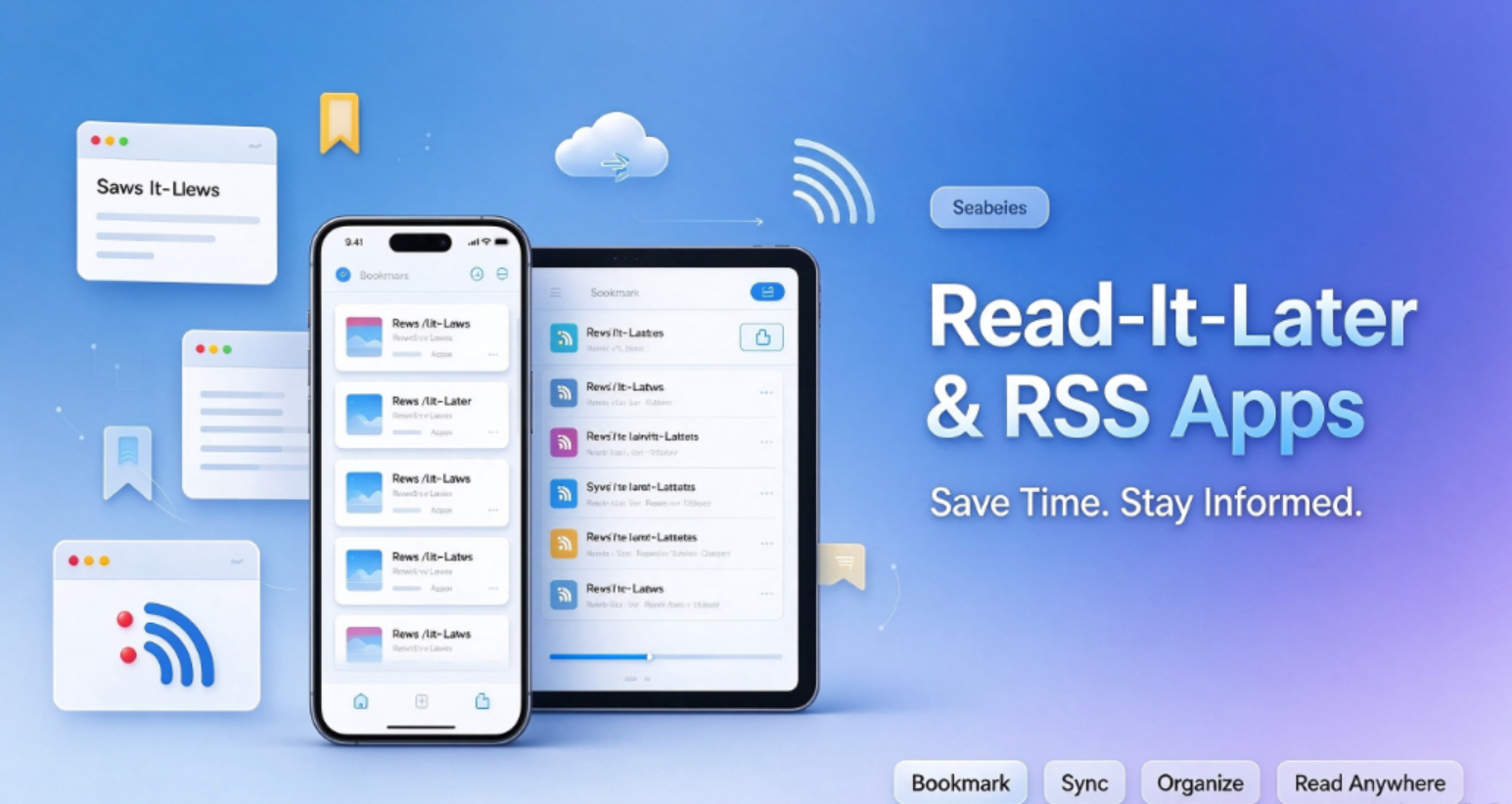
🖼️ Hero image suggestion: Minimal collage of a reading queue on phone + desktop RSS reader side by side, warm paper tones, overlay text “Own Your Feed 2026”
⚡ Key Takeaways
- RSS/feed-reader installs in the US/EU grew an estimated 34% year-over-year in 2025–2026, driven by X/Twitter algorithm fatigue and AI-slop flooding social feeds (est.).
- Readwise Reader leads the premium read-it-later segment (7.99/mo, AI highlights, YouTube transcript saving); Matter owns mobile-first audio reading; Reeder and NetNewsWire own the RSS purist niche (free–10 one-time).
- The average power user now saves 22 articles/month to read later and actually finishes 41% of them — vs a ~15% completion rate for links opened from social feeds (est.).
- AI summaries are the breakout feature: 63% of Reader users say “skip via AI summary, then read the good ones” is their default workflow (est.).
- Top limitation: discovery. RSS gives you control but no serendipity — 48% of users pair it with a newsletter digest or Reddit for finding new sources (est.).
After a decade of “RSS is dead” obituaries, the feed reader is back — not as a nostalgia product, but as infrastructure for people exhausted by algorithmic feeds and AI-generated content sludge. This page reviews the leading read-it-later and RSS apps used by US and European readers in 2026: what they cost, where AI genuinely helps, and where the category still falls short. The honest headline: you will read less junk and more of what you chose — but finding new good sources becomes your job again.
The headline numbers
Five statistics defining the category right now.
Adoption is quietly surging: feed-reader installs grew ~34% YoY in 2025–2026 in the US/EU app stores (est.), with the steepest growth among 25–40-year-old knowledge workers.
Completion rates are the killer stat: readers finish ~41% of articles saved to a read-it-later queue versus ~15% of links tapped from algorithmic feeds (est.). Choosing deliberately beats being pushed.
Pricing splits the market: premium read-it-later (Readwise Reader, Matter) runs 5–8/mo; pure RSS readers are cheap or free — NetNewsWire is free/open source, Reeder is ~$10 one-time on Apple platforms.
AI usage is mainstream inside these apps: an estimated 63% of Reader subscribers use AI summaries to triage queues before deep-reading (est.).
The discovery gap persists: 48% of RSS users still rely on newsletters, Reddit, or Hacker News to find sources — RSS curates, it does not discover (est.).
🖼️ Image suggestion: Bar chart — read-it-later completion (~41%) vs social-feed link completion (~15%)
Where each app delivers real value
Readwise Reader — the AI-powered everything box. Save articles, PDFs, Twitter threads, and YouTube videos; get AI summaries and spaced-repetition flashcards from highlights. $7.99/mo standalone. Best for researchers and newsletter addicts. Weakness: browser extension sync occasionally lags on paywalled sites.
Matter — mobile reading that respects you. Gorgeous iOS reading queue with human-quality text-to-speech and a social layer for seeing what friends save. Free tier is generous; premium adds full audio. Best for commuters. Weakness: Android support trails iOS.
Reeder — the Apple-ecosystem RSS classic. One-time ~$10 purchase, iCloud sync, supports RSS, Mastodon, and YouTube feeds in one timeline. Best for RSS purists who want polish without subscriptions. Weakness: no AI, no highlighting system.
NetNewsWire — free, open source, Mac/iOS only. The anti-bloat choice: fast, private, synced via iCloud or your own service. Best for minimalists and developers. Weakness: bare-bones by design — no read-it-later queueing, no sync with highlight tools out of the box.
The key distinction: Readwise/Matter are reading queues (save now, triage later); Reeder/NetNewsWire are feed infrastructure (everything from sources you chose, newest first). Power users run one of each.
Strengths vs hidden downsides
Core strengths
- Algorithm-free reading: chronological, complete, no engagement optimization.
- AI triage actually works: summarize 30 saved articles in minutes, deep-read the 5 that matter.
- Ownership: your reading history and highlights export cleanly — no platform lock-in.
Key downsides
- Discovery dies: no algorithm also means no serendipity; you must build your own source list.
- Paywall friction: RSS gives you headlines, not articles, for most premium pubs.
- Queue guilt: the “someday” pile grows; 41% completion also means 59% abandonment (est.).
- Fragmentation: highlights in Reader don’t talk to highlights in Matter; syncing across apps is DIY.
The 2026 reality: read-it-later + RSS is the counterculture stack for people who decided their attention is not a growth metric.
Algorithmic Feeds vs Read-It-Later/RSS
|
Metric |
X/Twitter, LinkedIn feeds |
Read-it-later + RSS stack |
|---|---|---|
|
Ordering |
Engagement-optimized |
Chronological / your choice |
|
Completion rate |
~15% (est.) |
~41% (est.) |
|
AI role |
Feed you more of what engages |
Summarize and triage your queue |
|
Ads / slop |
High |
None |
|
Cost |
Free (you pay with attention) |
0–8/mo |
|
Discovery |
Automated |
Manual curation |
🖼️ Image suggestion: Minimal two-column comparison graphic, warm minimal web style
Predictions through 2030
Expect the category to keep compounding: as AI-generated content floods algorithmic feeds, human-curated RSS becomes the quality layer — analysts project the RSS/reader market to roughly double by 2029 (est.). AI agents will increasingly auto-triage queues (drafting daily “read these three” digests from your saved pile), and cross-app highlight sync will standardize via open protocols. The biggest risk: premium reader apps get squeezed between free OS-level features (Apple’s Reading List with on-device AI) and newsletters moving behind hard paywalls. The biggest opportunity: readers-as-filters — paid curated feeds from trusted humans, distributed over RSS.
Frequently Asked Questions
❓ Is RSS really growing in 2026?
Yes — installs grew an estimated 34% YoY (est.), fueled by algorithm fatigue and the AI-content flood. It’s still niche relative to social, but the growth slope is real.
❓ Readwise Reader or Matter?
Reader if you save PDFs, YouTube videos, and want flashcard-style review; Matter if you read mostly articles on an iPhone and want excellent audio playback.
❓ Do I need both an RSS reader and a read-it-later app?
Power users do: RSS for sources you always read, read-it-later for one-off saves. Casual users can start with just one.
❓ Can AI summarize my reading queue?
Yes — Reader and Matter both offer AI summaries; Reader also lets you query across everything you’ve saved and highlighted.
❓ What happened to my old RSS feeds from the 2010s?
They probably still work. RSS never died — most blogs and news sites still publish feeds; you can import an old OPML file into any modern reader in one step.